
Below are the links to the latest research to support sustainable groundwater management across the Salinas River Valley and its subbasins.
Click on each link to preview and download the report.
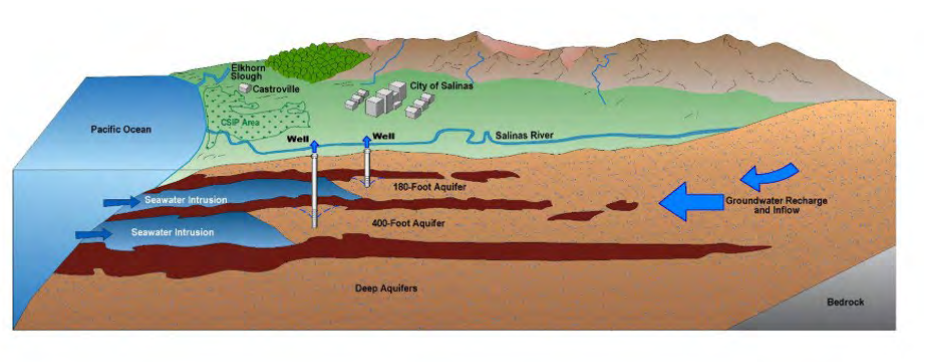
Brackish Groundwater Restoration Project Feasibility Study – Salinas Valley Basin Groundwater Sustainability Agency
According to the report linked above and here: “The Brackish Groundwater Restoration Project (BGRP) has the potential to generate substantial volumes of brackish water from creation of the extraction barrier that could be treated for use as a supplemental (potable or non-potable) water supply or for
recharge by injecting into the 180-Foot and 400-Foot Aquifers.
Development of a seawater intrusion extraction barrier is intended to protect the 180/400 and Monterey
Subbasins from advancing seawater intrusion and to reduce the salinity in the currently intruded areas,
while the alternative water supply will provide a high-quality water for the region. These actions are
critical for providing sustainable groundwater for the agricultural, urban, and environmental users in this
region.” Read the full report here.
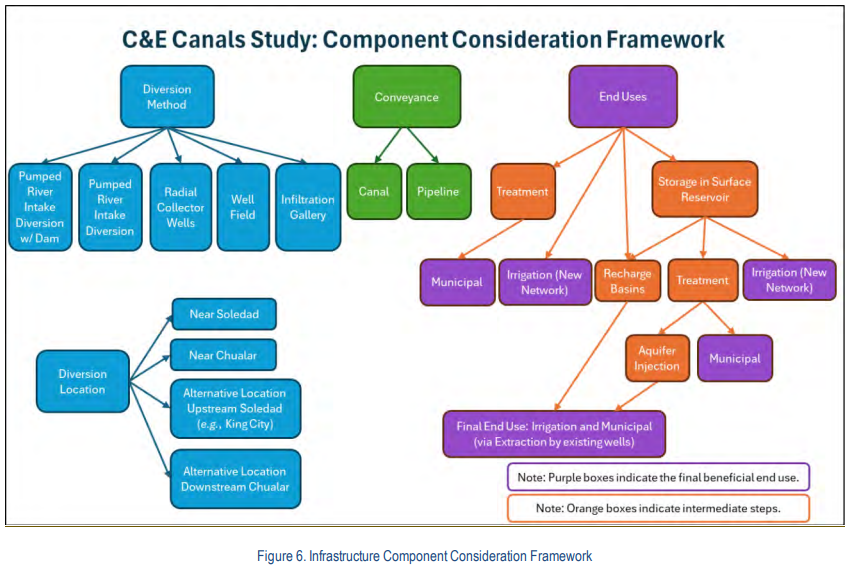
Engineers’ Summary Report for Castroville and Eastside Canals and Alternatives Preliminary Feasibility Study (C&E Study)
According to the report linked above and here: “The C&E Study evaluates the feasibility of using Salinas River surface water—primarily under MCWRA’s Water Right Permit 11043—to address 4 prioritized groundwater sustainability goals:
- Raise groundwater levels in the central and/or southern Eastside and 180/400 Subbasins
- Raise groundwater levels in the northern Eastside Subbasin
- Stop seawater intrusion
- Raise groundwater levels in the Deep Aquifers and seawater intruded area
The Study conducted preliminary analyses to develop 4 project concepts, supported by
evaluations of water rights feasibility, historical and projected river flows, infrastructure
requirements, groundwater modeling, preliminary cost estimates, and environmental permitting
considerations.” Read the full report here and find more information on the C&E Study here.
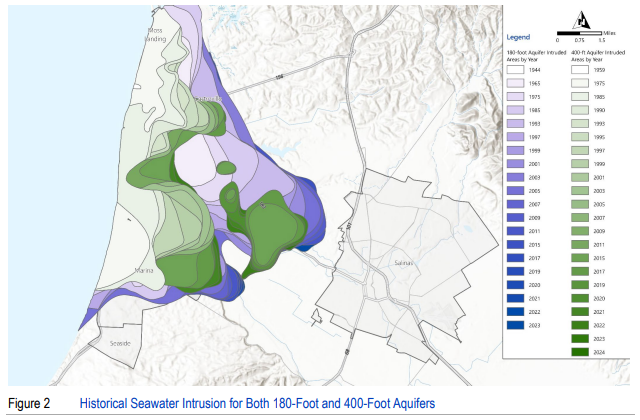
Technical Memorandum on the New Seawater Intrusion Project Evaluation – SVBGSA
The Salinas Valley Basin Groundwater Sustainability Agency has released a new memo detailing the latest developments with NSIP. According to the memo, linked here, “The scope of this feasibility study includes the following components:
- Investigate potential source water that can be utilized to supply NSIP
- Identify and prioritize areas and users that could be served by the potential sources.
- Consider the ability to expand the delivery of established and new supplies to meet existing and
future demands in areas at risk of seawater intrusion. - Identify infrastructure systems that will be used for delivery and project alternative definition.
- Develop project alternatives for paired source water and infrastructure systems.
Three NSIP project scenarios were identified to address seawater intrusion in the 180/400 and are described in detail in this memo:
- Maximum delivery to maintain existing irrigation demand for the entire NSIP area as a standalone system.
- Regions within the NSIP study area boundary that are within the seawater intruded regions of the 180/400-foot aquifers as defined by the existing isocontour of 500 milligrams per liter (mg/L) chloride levels.
- Phased implementation of the NSIP system as an expansion of the existing CSIP system.
Read the full report and download here.
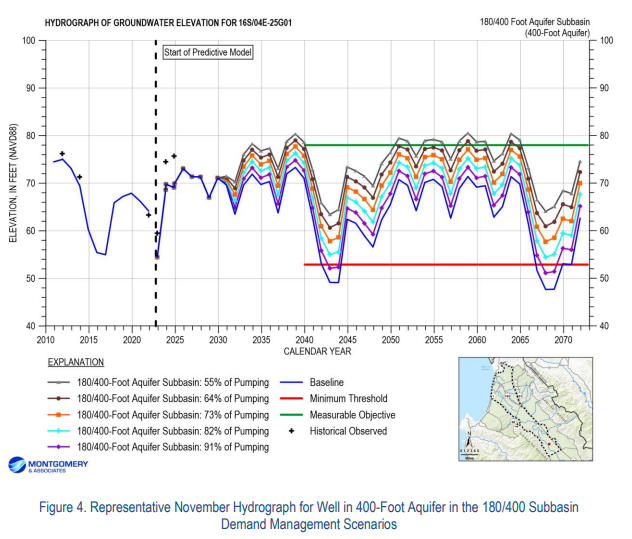
Technical Memorandum on Groundwater Impacts from Demand Management
Water resource consulting firm Montgomery & Associates has released this memo to “to evaluate how varying levels of groundwater pumping reductions affect groundwater levels.”
The firm explains, “the approach reduces pumping incrementally within each respective subbasin, while holding reservoir releases and pumping constant in the others, to identify a range of reduction levels
needed to achieve sustainability through demand management alone.” Read more here.
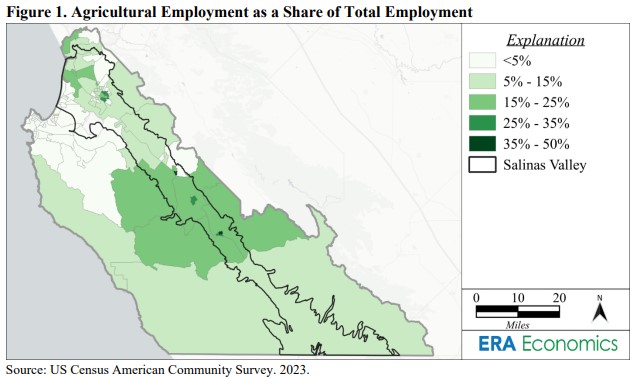
Demand Management Economic Analysis
Data analysts ERA Economics provided this report illustrating the impacts of demand management framework on the Salinas Valley. This analysis, “integrates groundwater modeling that provides a range of illustrative pumping limits into an economic analysis to assess how reductions in groundwater pumping affect agricultural production, regional economic output, employment, and income. The analysis additionally quantifies the direct cost of various domestic and agricultural demand management measures.”
No responses yet